 READY TO GET VIBIN'? FREE Sensual Care with Orders Over $50. Grab Yours!

Rope Bondage for Beginners: How to Tie, Play, and Stay Safe
TL;DR: Rope Bondage Basics
- Start with soft cotton or bamboo rope in 6mm thickness and 15-25 foot lengths. You don’t need expensive jute or hemp to begin.
- Learn two ties: a single-column tie (one wrist or ankle) and a double-column tie (two wrists together). These are the foundation for everything else.
- Safety essentials: keep EMT shears within arm’s reach, check circulation every 10-15 minutes, establish a safe word before you start, and never leave a tied person alone.
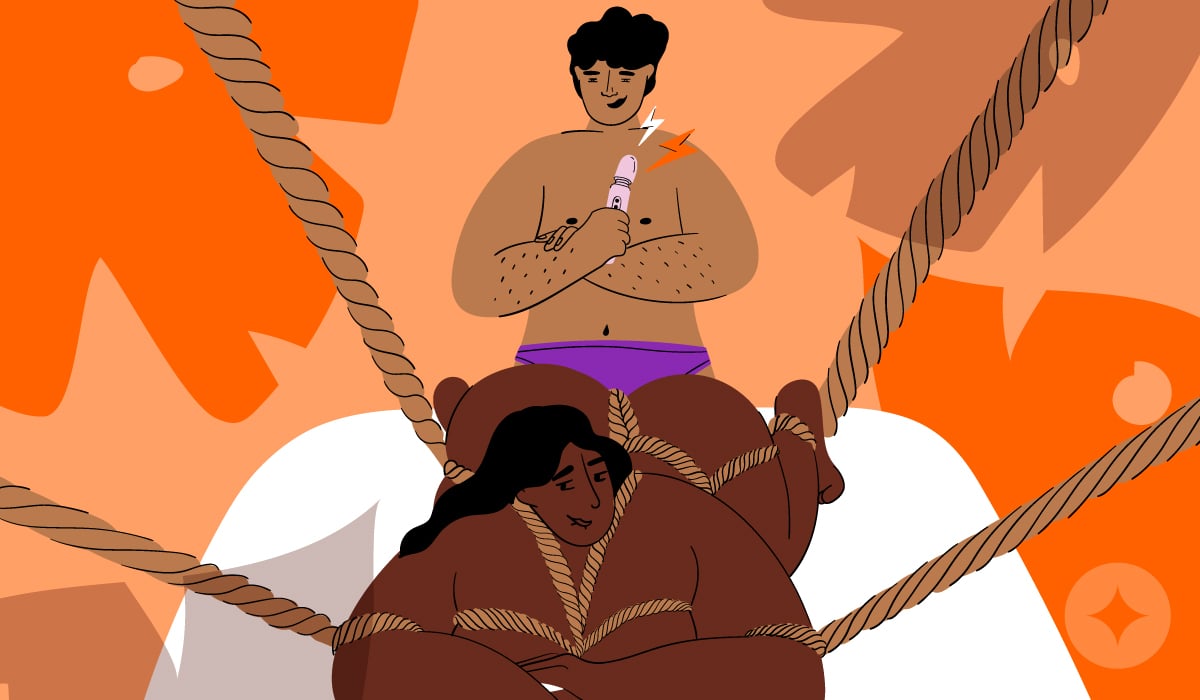
- What you do once your partner is tied matters as much as the tying itself. Sensory play, teasing with a vibrator, oral sex, and orgasm denial all pair naturally with restraint.
- Rope bondage works for every body and every relationship configuration. The principles of safety, communication, and consent are universal.
Read on to master essential techniques, explore safety practices, and discover how to incorporate rope bondage into your intimate life.
Why Rope (And Not Just Cuffs)
You can restrain someone with handcuffs in about three seconds. So why would anyone bother with rope?
Because rope bondage is a completely different experience. The process of being tied is itself an intimate act – your partner’s hands wrapping rope around your skin, adjusting tension, creating patterns across your body. It takes time. It requires attention. And that slow, deliberate contact builds arousal and trust in a way that clicking a set of cuffs closed simply doesn’t match.
Rope also gives you control over exactly how much restriction you’re applying and where. Cuffs are binary – on or off, one position. Rope adapts to any body, any position, and any level of restraint from loose and symbolic to genuinely immobilizing. You can bind wrists in front or behind the back, tie ankles to thighs, create chest harnesses, or simply wrap a few loops around your partner’s wrists and tie them to the headboard. The range is as wide as your imagination and comfort level.
And there’s the aesthetic dimension. Rope against skin looks and feels beautiful. The visual of your partner wrapped in carefully placed lines, combined with the sensation of compression and restriction, creates something that no other bondage tool replicates.
Choosing Your First Rope
Don’t overthink this. You do not need conditioned Japanese jute or artisan hemp for your first bedroom session. Here’s what actually matters.
Material. Cotton is the best starting point. It’s soft on skin, holds knots well, washes easily, and is cheap enough that you won’t stress about cutting it in an emergency. Bamboo rope is another beginner-friendly option with a slightly silkier feel. Save jute and hemp for later – they require conditioning, can irritate sensitive skin, and are more suited to decorative shibari than casual bedroom play.
Thickness. 6mm (roughly 1/4 inch) is the standard for bondage. It’s thick enough to distribute pressure across skin without digging in, and thin enough to tie clean knots. Avoid anything thinner than 5mm for wrist and ankle ties, since thinner rope concentrates pressure and increases nerve damage risk.
Length. Start with two or three pieces in 15-25 foot lengths. Shorter ropes are easier to manage and less likely to tangle. You can always connect multiple shorter lengths together if you need more, which is actually easier than wrestling with one enormous piece.
Le Wand carries bondage rope in 3m, 5m, and 10m lengths specifically designed for bedroom play – soft enough for sensitive skin, with enough grip to hold ties without constant retying.
Safety shears. Non-negotiable. EMT shears (the kind with a blunt tip that won’t cut skin) go next to the bed before any rope comes out. If a knot gets too tight, if your partner panics, or if anything goes wrong, you need to be able to cut someone free in seconds. Never start a session without them within arm’s reach.
The Two Ties You Actually Need
You could spend months learning elaborate shibari patterns. You don’t need to. Two foundational ties handle 90% of beginner bedroom bondage.
The Single-Column Tie
This ties rope around one “column” – a wrist, an ankle, a bedpost, a thigh. It’s the basic cuff that everything else builds from.
Find the center of your rope (the bight). Wrap it around the wrist twice, keeping the wraps flat and parallel – no twisting or overlapping. You should be able to slide two fingers between the rope and skin. Cross the bight over the working ends on the outside of the wrist (not the sensitive inner wrist where nerves run close to the surface). Tie off with a simple overhand knot or half hitch. The knot sits on the back of the wrist, away from delicate nerve pathways.
That’s it. One cuff, secure enough to hold position but loose enough to maintain circulation. From here, you can use the remaining rope to tie the wrist to a headboard, a thigh, the other wrist, or anything else stable.
The Double-Column Tie
This ties two columns together – both wrists, a wrist and an ankle, an ankle and a chair leg. Same principle, slightly different execution.
Place both wrists together. Find the bight, wrap around both wrists twice with flat, parallel wraps. Leave enough slack in the bight for what comes next: cross it between the two wrists (in the gap), wrap it around the ropes that connect the two columns (not around the wrists themselves), and tie off. The cinch between the wrists prevents them from tightening against each other, which is what makes this tie safe for sustained use.
Practice both ties on your own leg or a chair leg before using them on a partner. Repetition builds the muscle memory that lets you tie smoothly and confidently rather than fumbling with rope while your partner waits.
Safety Rules That Are Actually Non-Negotiable
Rope bondage carries real risks. Nerve damage is the most serious – it can happen quickly, sometimes without obvious symptoms, and in rare cases can be permanent. These rules exist to prevent that.
Two-finger rule. You should always be able to slide two fingers between the rope and skin. If you can’t, it’s too tight. Check this during tying and again every 10-15 minutes.
Know the danger zones. Never place rope directly over the inner wrist, the inner elbow, the armpit, the front of the neck, or the back of the knee. These are areas where major nerves run close to the surface. Rope pressure on these spots can cause numbness, tingling, or nerve injury even at moderate tension.
Check circulation regularly. Ask your tied partner to wiggle their fingers and toes every 10-15 minutes. Skin color changes (turning white, blue, or significantly darker), temperature drops, numbness, or tingling are signals to adjust or remove rope immediately.
Safe word, every time. Agree on a word that means “stop everything and untie me now” before you start. “Red” is common. For situations where a gag or position makes speaking difficult, establish a non-verbal signal too – dropping a held object, tapping a specific pattern, or humming a specific tone.
Never leave a tied person alone. Not for a minute. Not to answer the door, grab water from the kitchen, or check your phone. The tying partner stays present and attentive for the entire duration.
Time limits for beginners. Keep tied positions under 20-30 minutes while you’re learning. Even comfortable ties can cause circulation issues over longer periods, and you need experience to recognize the early warning signs.
For a deeper dive into safe power exchange, our BDSM power exchange guide covers negotiation, consent frameworks, and communication protocols that apply to all bondage play.
What to Actually Do Once They’re Tied
This is the part most rope guides skip entirely – they teach you the ties and then leave you staring at your beautifully bound partner wondering “now what?” The tying is foreplay. What comes next is the main event.
Sensory Play
A restrained partner can’t see what’s coming or brace for it, which makes every touch more intense. Add a blindfold and the amplification doubles. Run different textures across their skin – fingertips, ice, a feather, the edge of a piece of rope, a warm breath. Alternate between predictable and surprising touches. The contrast between “I know what’s coming” and “I have no idea” keeps their nervous system on high alert.
Vibrator Play on a Restrained Partner
This is where rope bondage and sex toys combine into something neither does alone. When your partner can’t move away from a vibrator, they can’t control the stimulation – you do. A wand vibrator held against a restrained partner’s clitoris, frenulum, or perineum delivers a level of intensity they can’t escape from, which is exactly the point.
Start with the vibrator on areas away from the genitals – inner thighs, nipples, lower belly, the crease of the hip. Build anticipation. When you finally move to the genitals, start on the lowest setting and increase slowly. The combination of immobility and escalating vibration creates an arousal that builds faster and peaks harder than either element alone.
The Le Wand Bullet or Le Wand Point can be tucked into a rope harness or crotch rope, held in place by the tension of the tie itself. This creates hands-free vibration that the restrained partner feels constantly, while you use your hands for other stimulation. The broader head of the Le Wand Original is better for holding against a tied partner manually, since the handle length gives you reach without getting in the way of the ropes.
Orgasm Denial and Forced Orgasm
Restraint makes orgasm denial devastatingly effective. Your partner can’t touch themselves to finish what you started, and they can’t push the vibrator away when things get too intense. You control whether they come, when, and how.
Build them to the edge with a vibrator, then remove it. Let arousal drop. Build again. The helplessness of being unable to do anything about it except ask (or beg) makes each cycle more intense than the last.
Forced orgasm is the reverse – sustained, unrelenting stimulation that your partner can’t escape because they’re tied. A powerful wand held firmly in place through the orgasm and beyond, into the hypersensitive aftermath. Discuss this one carefully beforehand and have your safe word locked in.
Oral Sex and Manual Stimulation
Tie your partner’s wrists to the headboard and go down on them. They can’t guide your head, grip the sheets, or rush the pace – they just receive. Or tie their wrists behind their back and have them go down on you, adding an element of challenge and vulnerability to the act. Rope doesn’t have to be complicated to transform the dynamic of something you’d normally do without restraint.
For more ways to combine toys with bondage positions, our guide to sex positions with toys covers specific configurations.
Aftercare for Rope Play
Untying your partner isn’t the end of the session. It’s the beginning of the recovery period.
Physical aftercare. Remove rope gently and check for marks. Some marking is normal and fades within hours. Deep grooves, persistent redness, or any numbness after the rope is removed warrants attention. Massage areas where rope sat to restore circulation. Offer water, a blanket, and snacks. The body has been in an unusual position under physical stress, and it needs practical care.
Emotional aftercare. Being tied up involves vulnerability, trust, and often intense emotional release. Your partner may feel euphoric, tearful, clingy, or spaced out after a session. All of that is normal. Stay close, maintain physical contact, and offer verbal reassurance. “You were incredible.” “How are you feeling?” “I’ve got you.”
The tying partner needs aftercare too. Holding responsibility for someone else’s physical safety and pleasure is its own kind of intense. Talk about what worked, what surprised you, and what you’d adjust next time.
Frequently Asked Questions
What if I can’t tie knots to save my life?
Good news: you need exactly two knots. The single-column tie and the double-column tie handle almost every beginner scenario. Practice each one ten times on a chair leg. That’s genuinely all the preparation you need before trying them on a person.
Is rope bondage safe?
It carries real risks – primarily nerve damage and circulation restriction – that require education and attention to manage. Following the safety rules in this guide (two-finger check, avoiding danger zones, time limits, safety shears) makes the practice significantly safer. It’s never risk-free, but with proper care, millions of people practice it without injury.
Can I try rope bondage solo?
Yes. Self-tying is a legitimate practice, especially for learning technique and exploring how rope feels on your body. The key safety rule: never put yourself in a position you can’t free yourself from. Keep shears within reach and avoid any tie that restricts breathing or could tighten unpredictably.
What’s the difference between rope bondage and shibari?
Shibari (Japanese rope bondage) is a specific tradition with aesthetic and cultural roots that emphasize the art and emotional process of tying. “Rope bondage” is the broader category that includes any use of rope for restraint. You can do bedroom rope bondage without doing shibari, though many beginners eventually explore shibari techniques as they develop their skills.
How do I bring up wanting to try this with my partner?
Outside the bedroom, casually. “I’ve been curious about trying rope bondage – would you be open to exploring that?” frames it as a shared adventure rather than a demand. Share this guide or a similar resource so your partner can learn alongside you. Buying rope and learning the basic ties together can be its own form of foreplay.
Start With One Tie Tonight
Buy some rope. Learn the single-column tie. Tie your partner’s wrists to the headboard. Add a blindfold and a vibrator on a low setting. Check in throughout, untie them when you’re done, and hold them close afterward.
That’s a complete first rope bondage experience. Everything else, the elaborate ties, the chest harnesses, the creative positions, builds from there at whatever pace feels right.
For more on restraint play, explore our bondage accessories collection, our gentle femdom guide, and our guide on BDSM power exchange dynamics.